How Geopolitics and Heritage are Rewriting the Cap Tables
For the past decade, the global venture capital market operated on a simple premise: borderless liquidity. Capital flowed to the best ideas, regardless of jurisdiction. An investor in Dubai or Singapore could effortlessly hold secondary equity in a Silicon Valley darling.
Today, that premise is gone.
As artificial intelligence and deep tech mature from software tools into national security infrastructure, the free flow of capital has hit a wall. Governments and founders are erecting geopolitical fortresses around their cap tables. In the 2026 secondary market, having the capital to buy a block of AI equity is only 10% of the battle. The other 90% is proving you have the right passport, the right jurisdiction, and the right “heritage” to be allowed in the room.
The Geopolitical Fortress
We are watching the fragmentation of the tech economy in real time.
The catalysts go far beyond the conflicts in Ukraine and the Middle East. Governments are actively weaponizing trade. Through semiconductor embargoes, escalating tariffs, and chip export restrictions, new market frictions are emerging daily.
Superpowers are carving the global market into proprietary zones. The US wields aggressive export controls, China enforces domestic walled gardens, and the EU uses ‘sovereign AI’ mandates to force data localization. As a result, foreign access to top technology is being systematically choked off.
Look at the semiconductor market. ASML in Holland remains the leading company in the world for making chips. But in recent years, we saw the US entity dictating that to work with US markets, physical infrastructure had to move closer to home, resulting in ASML extending its presence to Austin, Texas to secure the supply chain on American soil. The logic is simple: if you own the physical infrastructure in your country, you control the biggest part of the market.
The software itself is now classified as a weapon. Take the sudden suspension of Anthropic’s Fable 5. Days after Anthropic launched its most capable model, the US government issued an emergency export control directive citing national security. Anthropic was forced to instantly rip access away from all foreign nationals globally.
Governments are realizing that data and compute are the new oil, and they do not want foreign entities owning the pipelines.
The Valuation Gap of Isolated Markets
This localization creates a friction point for secondary liquidity. When you lock a company behind a national firewall, you cut off its access to global capital multipliers.
Take China as an example. Right now, any foreign party is shut out of direct equity ownership in a Chinese AI company. We have had chats with major players in China recently, and all of them tell the same thing: if you are not a Chinese company, you cannot get in.
Everybody knows DeepSeek. Look under the hood at models like Moonshot’s Kimi or Zhipu’s GLM — they deliver benchmark results in the exact same tier as OpenAI and Anthropic. Yet the valuation gap is 15 to 20x.
While Anthropic commands a $965 billion valuation and OpenAI sits near $852 billion, DeepSeek recently cleared a round at roughly $55 billion. Moonshot hovers around $20 billion.
Why the massive haircut? The geopolitical fortress cuts both ways. First, by being restricted to monetizing the domestic Chinese market, they face a brutal revenue ceiling. Anthropic runs at an estimated $47 billion annualized rate, while Moonshot pulls in roughly $200 million. Second, US export controls choke their access to frontier compute. Ultimately, global investors apply a systemic geopolitical penalty to the equity.
When an asset is legally restricted to a specific regional liquidity pool and carries inherent governance risks, it drastically suppresses the valuation.
Contrast this with purely financial infrastructure, which still scales borderlessly. A decentralized exchange like Hyperliquid has grown in the last 9 months from 8% to current 14.4% of Binance’s volume; a B2B platform like Ramp commands massive multiples because they ship and deploy globally without sovereign friction.
But in the AI arms race, that borderless scaling is no longer allowed.
The geopolitical moat protects the company, but it traps the early investors.
The “Old Boys Club” and the Heritage Premium
This dynamic isn’t just happening in emerging markets. It is happening at the absolute apex of the US tech ecosystem, driven not just by regulators, but by founders and boards.
Founders of Tier-1 AI companies are actively policing their cap tables: money is just money; they want brand equity.
We experienced this firsthand. Recently, SecondLane had a potential option to access a primary round in Anthropic. We had the capital. But we got outvoted by a well known large US bank, and the company chose the institutional name over us.
It is 100% understandable. From a founder’s perspective, it is much easier to say, “This stake is held by major US bank,” or “This is owned by a Prince or a Sovereign Wealth Fund,” than saying it is held by an anonymous offshore SPV.
Consider the Public Investment Fund (PIF) – Saudi Arabia’s sovereign wealth fund, chaired by Crown Prince Mohammed bin Salman. By mid-2026, PIF’s Assets Under Management (AUM) exploded to $925 Billion. PIF’s US 13F filings show they hold massive multi-billion-dollar stakes in Uber, Lucid Group, and Electronic Arts.
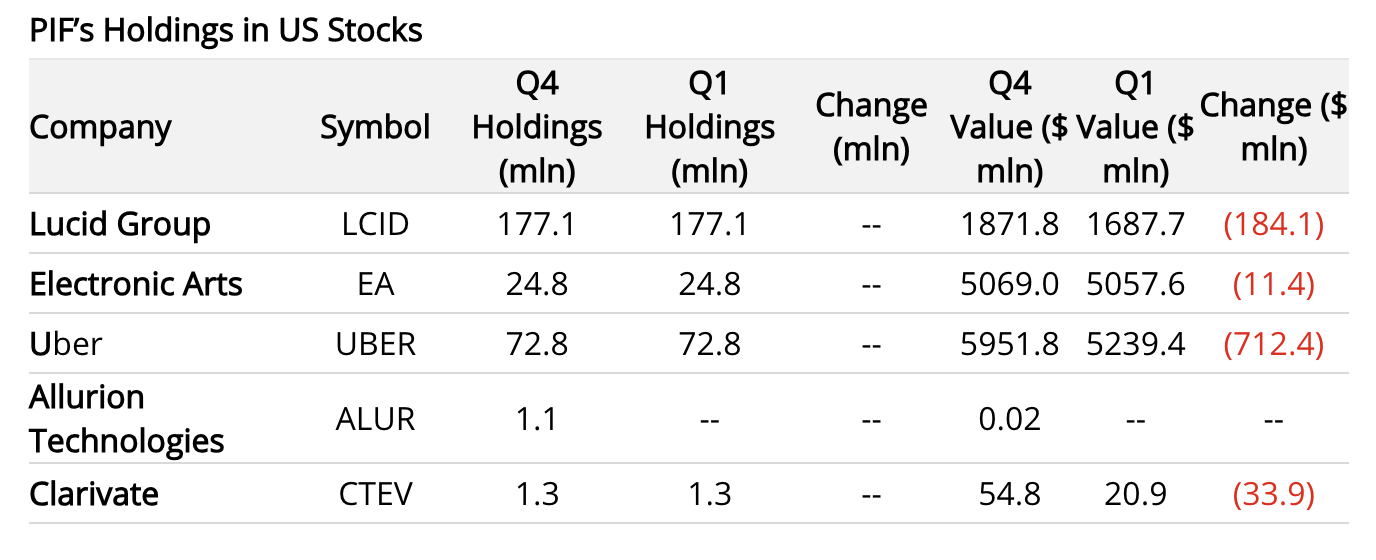
Founders and governments allow PIF onto their cap tables because having a top-tier sovereign wealth fund globally validates the company. It is the heritage stamp of approval.
Heritage is a massive vetting mechanism. In these elite circles, this goes back to an “old boys club” mentality. Every dollar gets traced back to a name, a family, a flag. If you aren’t known within that circle, or if you don’t have the heritage branding, you aren’t getting on the cap table.
This heritage effect also acts as a regulatory shield. Look at Wall Street’s integration with offshore digital assets. Cantor Fitzgerald acquired a ~5% equity stake in Tether while acting as the custodian for its US Treasury reserves. By letting a legacy Wall Street giant onto its cap table, Tether anchored its offshore ecosystem into the US financial system, setting the stage for a $500 Billion private valuation in early 2026.
How Agencies Access Through the Wall
How does a global buyer clear a trade in the restricted environment? Through pre-approved localized partnerships.
A foreign party trying to get access to business in the UAE must partner with a local fund. Across Asia and the US, regulators like CFIUS scrutinize foreign capital entering AI cap tables.
Identify a domestic institution or legacy GP who has needed access and approval, partner with them, and move LP capital into a localized SPV with local optics and regulations. That’s how the secondary brokers fluent in the language of national security and heritage partnerships act.
Without this skill, your capital stays outside the wall.
Omar Shakeeb, CEO & Co-Founder SecondLane
Frequently Asked Questions
Why can’t foreign investors buy equity in Chinese AI companies?
Right now, foreign parties are effectively shut out of direct equity ownership in Chinese AI companies. China enforces domestic walled gardens, and market participants consistently report the same thing: if you are not a Chinese entity, you cannot get in. That restricts these companies to domestic liquidity and caps their access to global capital multipliers.
Why is DeepSeek valued so much lower than Anthropic or OpenAI?
Chinese labs like DeepSeek and Moonshot post benchmark results in the same tier as Anthropic and OpenAI, yet trade at a 15 to 20x discount. The gap reflects a geopolitical penalty: they are restricted to the domestic market, face a revenue ceiling, and US export controls choke their access to frontier compute.
What is the “heritage premium” in AI cap tables?
The heritage premium is the value founders and boards place on who holds their equity, not just how much capital arrives. A stake held by a major US bank or a sovereign wealth fund signals validation and lowers regulatory risk, so investors without recognised heritage are often passed over even when they have the capital in hand.
How can foreign investors access restricted AI cap tables?
Access usually runs through pre-approved local partnerships. A foreign buyer identifies a domestic institution or legacy GP that already has access and approval, partners with them, and moves LP capital into a localised SPV with local optics that satisfies regulators such as CFIUS. Without that structure, the capital stays outside the wall.
What is CFIUS and why does it matter for AI investments?
CFIUS, the Committee on Foreign Investment in the United States, reviews foreign investment into US companies for national security risk. For AI and deep-tech cap tables it can scrutinise or block foreign capital, which is why cross-border buyers increasingly route deals through localised, pre-approved structures.